Is accountability still possible (in the context of Australian Government structure)?

Is accountability still possible (in the context of Australian Government structure)?

In the Australian Government system , the accountability is of two types:

a)      Democracy – (the elected representatives of the Government are  accountable to the people). Members of the parliament are elected by the public vote and Government has a focus of public well being in order to be re-elected. In Australia, we also see democratic values within the parties as they have election process for electing leaders among themselves.

b)      Financial accountability – The Government plans its spending through its departments and  agencies in the form of budget which is approved in the parliament  and there are a number of  financial controls and audit process in order to monitor the performance of the Government against the approved budget.

The financial accountability cycle can be summarised in the following pictorial representation:

Figure:  The cycle of commonwealth financial accountability

(adapted from Public Sector Accounting and Accountability in Australia – Kathie Cooper, Warwick Funnell, Janet Lee)
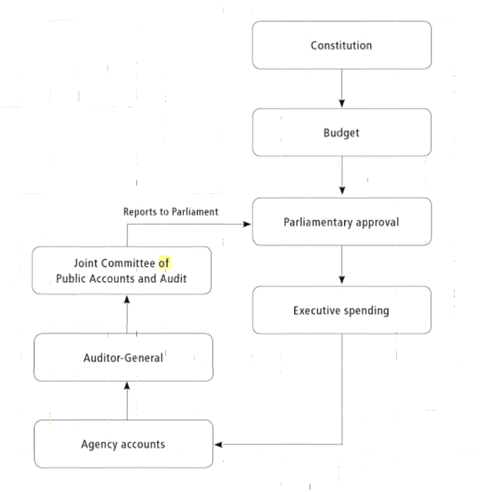
The cycle of commonwealth financial accountability

The cycle of commonwealth financial accountability

Thus we see a chain of accountability from electorate to the performance of agencies.  Following diagram summarizes the chain of accountability in the Australian Government system:

Figure: The Chain of Accountability

(adapted from Public Sector Accounting and Accountability in Australia – Kathie Cooper, Warwick Funnell, Janet Lee)

The Chain of Accountability

The Chain of Accountability

The departments and agencies and thus the Government is further assessed on the bases of effectiveness, efficiency and economy when spending the public money.

Figure: The public sector accountability and performance continuum

(adapted from Public Sector Accounting and Accountability in Australia – Kathie Cooper, Warwick Funnell, Janet Lee)

The public sector accountability and performance continuum

The public sector accountability and performance continuum

We see that the Government is not judged by way of profit as in the case of private sector which makes public  sector accountability somewhat complex, nevertheless it is possible.

Standard

How has Australian government shifted from the constitutional ideals of 1901?

The constitutional ideals of 1901 included  to provide framework for national government so that united approach can be taken to the issues pertaining to transportation, trade, defense and immigration.

Before 1901 when the constitution was proclaimed, two important  meetings took place to discuss how to adopt a common approach on various matters  faced by the Australasian colonies (later on called “States” through the constitution). These included the informal meeting attended by official representatives from the Australasian colonies in 1890 and the first National Australasian Convention in Sydney in 1891. These two meetings are important as through these meetings the process of confederating the Australian colonies was expedited and the question of how to structure the new central government was considered.

The shape of the new constitution was such that a federation was constituted within  the Westminster tradition of government.The main examples of constitutional structures that were considered included Canadian and the US structures of governments.  In the US model few powers were given to the central government and majority of the decision making was held by the States.

Thus in the Australian model of government we see a compromise between the States and the Commonwealth. Apart from powers listed in the Constitution as belonging to the Commonwealth Government, residual powers were left with the States. To maintain fairness and to protect rights of the States, Senate was introduced based on the US model as one of the two houses of parliament represented by equal number of members from all the States.

We see the shift from monarchy to democracy in the formation of Australia. The hybrid structure that was proposed earlier and implemented in 1901 with the Constitution, the monarch and the Governor-General.

Standard

How has the Australian government shifted from the UK model of government

How has the Australian government shifted from the UK model of government

“As with many Commonwealth countries such as Canada and New Zealand, the Australian Government is established in the Westminster tradition. the Westminster tradition refers to the collection of legal rules, traditions, cultural expectations and administrative practices that shape the way the public service interacts with ministers and the government of the day. Australia has developed its own Westminster model, consistent with local values, ethics, culture, practice and constitutional arrangements.” (Ahead of the Game: Blueprint for the Reform of Australian Government Administration)

In 1901 Australia came out of six colonies of the Great Britain. These colonies were independent of each other and union the colonies mainly stems out from the need to resolve the issues pertaining to transportation, trade, defence and immigration of people hence a federation was required.

Consequently all the states were brought together by means of a formal written document : “Commonwealth of Australia Constitution” and Australia came into being with the Constitution, the monarch and the Governor-General.

In federalism powers are divided between a central government and several regional governments. Through the constitution, a federal system was created wherein power was divided between the  centre and the governments of the six colonies (renamed as States in the Constitution). Certain areas such as taxation, defence and foreign affairs were given to Commonwealth Government and list of those matters specified in the Section 51 of the Constitution. The states retained power over the matters that occurred within their borders. (Australia.gov.au)

To protect the interests of the states, Senate was formed as one of the two houses in the Parliament  represented by equal number of members from each State.

Following diagram summarizes the structure of Australian Government.

Structure

Standard